

READ: EPILOGUE & APPENDICES
book abstract
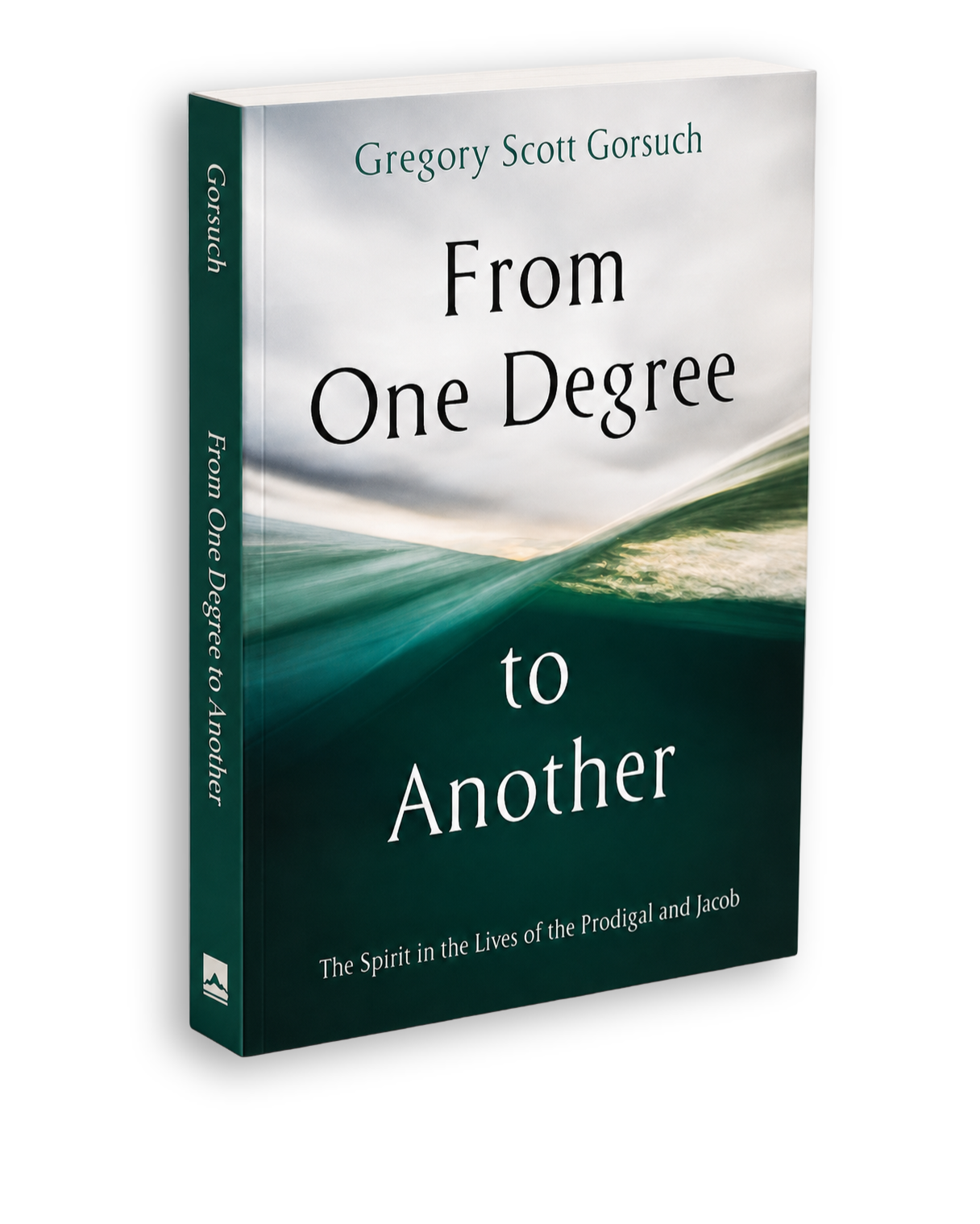
Why does God lift Jacob into preeminence in the same manner as Jesus does with Peter in the New Covenant? Why are these the only two in Scripture to receive complete name changes from God? And why the common theme of “rocks”? Coincidence? No — this is actually a game-changer.
Gorsuch’s new book tackles Jesus’ most difficult sayings while explaining the true depth of the stories of Jacob and the Prodigal Son — not only revealing greater coherence in the Scriptures but explaining how the human spirit grows in interactive, perichoretic individuation from one degree to another. What emerges is a relational ontology that explodes our conventional understanding of morality and metaphysics, revealing that all genuine faith, as expressed in the passion of Jacob and Peter, emerges from a holistic pre-cognitive, pre-temporal co-conditioning interaction that allows Jesus to say, “your faith [with me] has made you well.”
From One Degree To Another unlocks the mysteries of human freedom and divine providence, the problem of evil, and the ways the Trinity moves redemptively both within and beyond Christianity.
Advance Praise
for From One Degree to Another
Theologians, pastors, psychotherapists and teachers on Jacob, the Prodigal, and a faith that has to be ventured.
Steven G. Smith
Professor of Philosophy and Religious Studies, Millsaps College
The Concept of the Spiritual
What is the “redemption” we long for? Wouldn’t it be to have a future of becoming more intensely human, more loving and understanding, more ourselves and more Christlike—to be able to enter into deepened relationality like that of the returning prodigal son and his welcoming father in Jesus’s parable? Greg Gorsuch evokes spiritual wonder at the prospect of growing into ever greater degrees of intimacy with our fellow beings through venturesome, vulnerable, “cruciform” living.
Blaine Charette
Distinguished Professor of Biblical Studies, Northwest University
Restoring Presence: The Spirit in Matthew’s Gospel
In this insightful theological reflection on 2 Corinthians 3:18, Gorsuch invites us to expand our understanding of the divine narrative that is stifled and distorted by a church too restrained by fear to allow a full encounter with and transformation by God’s Spirit. The journeys of Jacob and the prodigal challenge us to live freer and more open lives informed by God’s love and creatively aligned with the mind of the Spirit.
Corneliu C. Simuț
Professor of Theology, Aurel Vlaicu University, Arad, Romania
Spiritual Formation
This is not a book for the (theologically) faint of heart. This is a book for those who like to wrestle not only with difficult questions about life and death (and what lies beyond them), but also with God himself. That is because, in the field of theology but also in life (and death, and life eternal), dealing with tough questions is a permanent fight with God, regardless of whether one believes in him or not. Do read this book if you want to find answers to hard questions and especially if you want to come across even more challenging questions whose answer is simply and forever God alone.
Jonathan Campbell, PhD
Intercultural Studies, Fuller Theological Seminary · Entrepreneur, Tahoma Ventures
Gorsuch turns the stories of Jacob, Peter and the Prodigal into an invitation—to risk, to wrestle, to be transformed from “one degree to another.” I know the ache he writes for: the seeker who finds Jesus unreservedly welcoming, but the church strangely closed. By relocating faith from the what of belief to the way of an open heart, he offers an authentic vision of church that both welcomes and transforms. Ambitious and integrative, this is a book that rewards wrestling. Like Jacob, they may walk away limping—and blessed.
Michael Lang
MA Teaching, Literature
In an age of automated atomization and pacification, Gorsuch is writing theology that names the crisis and gives its resistance an ontology: the spirit of individuated agency whose total and passionate relations embody the Trinitarian dance desired by divinity. God wants contenders for communion, and Gorsuch wants you to grasp what Jacob does.
Ned Abenroth, MDiv
Pastor, Wilderness Guide, Retreat Leader, Entrepreneur
In sync with Kierkegaard, Gorsuch draws out novel interpretations of old biblical stories most Christians assume they understand or simply ignore. The mystery of faith has never been about rules, morality, or believing a set of conclusions, nor is faith fixated on the past. Rather, Gorsuch invites us to join an ongoing collective unfolding that is relational at its core and requires passion, openness, and the willingness to venture it all.
Alan Beasley, MDiv
GTU Berkeley · Retired UPCUSA Pastor, Seattle
Gorsuch gives us remarkable insights into the story of Jacob and the prodigal son, as well as other important biblical texts. Through a wide range of disciplines, similar to James Loder’s efforts, he draws us deeper into the personal and relational growth shaped by God’s Spirit interacting directly with our spirit. It’s a cliché to talk about thinking outside the box, but that’s what Gorsuch does here, and it works to good effect.
Scott Burnett
Retired Clergy, Evangelical Covenant Church
From One Degree to Another is much more than this book’s title: it is its potency. Step by step, and with biblical rigor, Gorsuch leads readers toward an alternative path of Christian spiritual formation. Far from conformity to religion’s known (and static) axioms, here is a call for differentiated persons to perpetually wrestle their way into the newness of a relationship with Jesus.
Denny Gunderson
Retired Psychotherapist, Pastor, and Mission Leader
From One Degree to Another is a rare book that offers a fresh understanding of what some thinkers intuit but lack the originality or daring to articulate. Scholar-researcher Greg Gorsuch draws on Kierkegaard, James Loder, Moltmann, and others to plunge us into the heart of relationality. Using an interdisciplinary approach—encompassing theology, psychology, neurology, and science—this book will provoke, stretch, and may frustrate, but in the end will prove highly rewarding for serious readers.
Is the Church a static institution from the past, or a constantly transforming community that increasingly expresses the “Fullness of Time”? The epilogue and appendices challenge a static understanding of faith and belief, proposing instead a living, developmental theology in which the Spirit continually transforms humanity from one degree of glory to another.
By moving beyond moralizing constraints toward a relational theosis, it explores how the Church might better facilitate the redemptive process:
Preeminence of Spirit: Redemption begins with the Spirit, communicating the entire presence and activity of Christ in the world and guiding us into a living truth. Closing oneself to this transforming fullness is the only unforgivable sin.
Spirit as Relationship: Drawing on Kierkegaard and Trinitarian dynamics, personhood is redefined as spirit — a holistic and dynamic presence that envelopes the body and soul. To be Spirit is to experience passion, the venturing of our entire self to be affected by the genuine relations of the Other (love).
The “Between” of Communication: Truth is not merely distributed information but an intersubjective event that must re-incarnate with every unique encounter. The Church must acknowledge and utilize the truth and beauty in its surrounding culture, its films and arts, to speak to the primordial cry of the heart.
A Christian Pluralistic Hypothesis: We discover how Christ’s redemptive activity is active beyond the Church, silently calling everyone from within their respective relationships.
Co-Conditioning Freedom: Explore a tripartite ontology where human freedom and divine providence emerge together in a co-conditioning eternal moment. In this fullness of time, our longings and choices can freely affect the creating hand of Christ through the Spirit.
The Epilogue & Appendices show how these theological considerations begin to address the age-old problem of evil and the relationship between divine providence and human freedom. It also offers the Church a path to become a safe but transformative harbor for those longing for abundant life.